International Women’s Day
My parents came to the country in 1984 with two suitcases full of hopes and dreams of a good future for their daughters. They worked hard, and took any job they could to provide for us like most immigrants. In India, my father was an engineer and my mother was a teacher, but those titles held little weight in America requiring more school. When I see refugees on the news, my heart breaks seeing fathers in tears while carrying infants across the waters praying to Allah (SWT) they are safe. For a father to risk a 30 day journey with a young infant, he has to be fleeing something dangerous. Once the media left, the world stopped discussing the crisis. The politicians sensationalized it all by discussing stronger border control measures. In the States, I saw banners of “Refugees Welcome” during protests and it frustrates me because they aren’t welcome. They are stuck on the islands of Lesvos, the mountains of Serbia, and in abandoned buildings in Athens. As a daughter of immigrants and a PTSD Trauma Informed Therapist, I had to come here and offer a hand to our Ummah.
“Be grateful unto God – for he who is grateful [unto Him] is but grateful for the good of his own self” Surah 31:12.
I arrived in Lesvos, Greece trained to pull refugee boats in and was quickly shocked at the middle class refugees sharing their stories of smugglers, Turkish forests, and deceitful ransom costs.
“After 35 days, we finally were at the boat. They tried to take everything from us, they promised us life jackets. They said they had 5 for all 78 of us and auctioned it to the highest bidder. It’s a life jacket, it’s our lives. There were children on the boat. Allah (SWT) sees everything.”
During my night shifts, I clutched onto my Quran praying for every person on the water we don’t see, praying for everyone who crosses it, praying they make it safely across, praying no more bodies or empty boats arrive on the coast. Eighty people arrived every other day.
Eighty Dreams.
Eighty Hopes.
Eighty Fears.
Eighty Human Lives.
Eighty Members of Our Ummah.
After my volunteer term on the Islands ended, I prayed on how best to help our brothers and sisters with their many different layers of trauma starting at refugee camps, grassroots organizations, abandoned apartment buildings, and even on the outside tables of subway stations. Now, I lead a couple of free art workshops everyday in Greece with zero expectations except to create an hour of safety and normalization of feelings for refugees. Dignity, trust, and safety are crucial elements of every workshop that I facilitate. When they see that others are sharing stories of missing home or mourning losses, they get a sense of courage to express similar feelings and let go of the taboo of expressing emotions. There are so many layers of trauma from the war back home, to over 30 day walks, to dangerous forests and high waves swallowing lives. They shared about the constant media discrimination criminalizing them for not wanting to die in war. They have the human right to choose life.
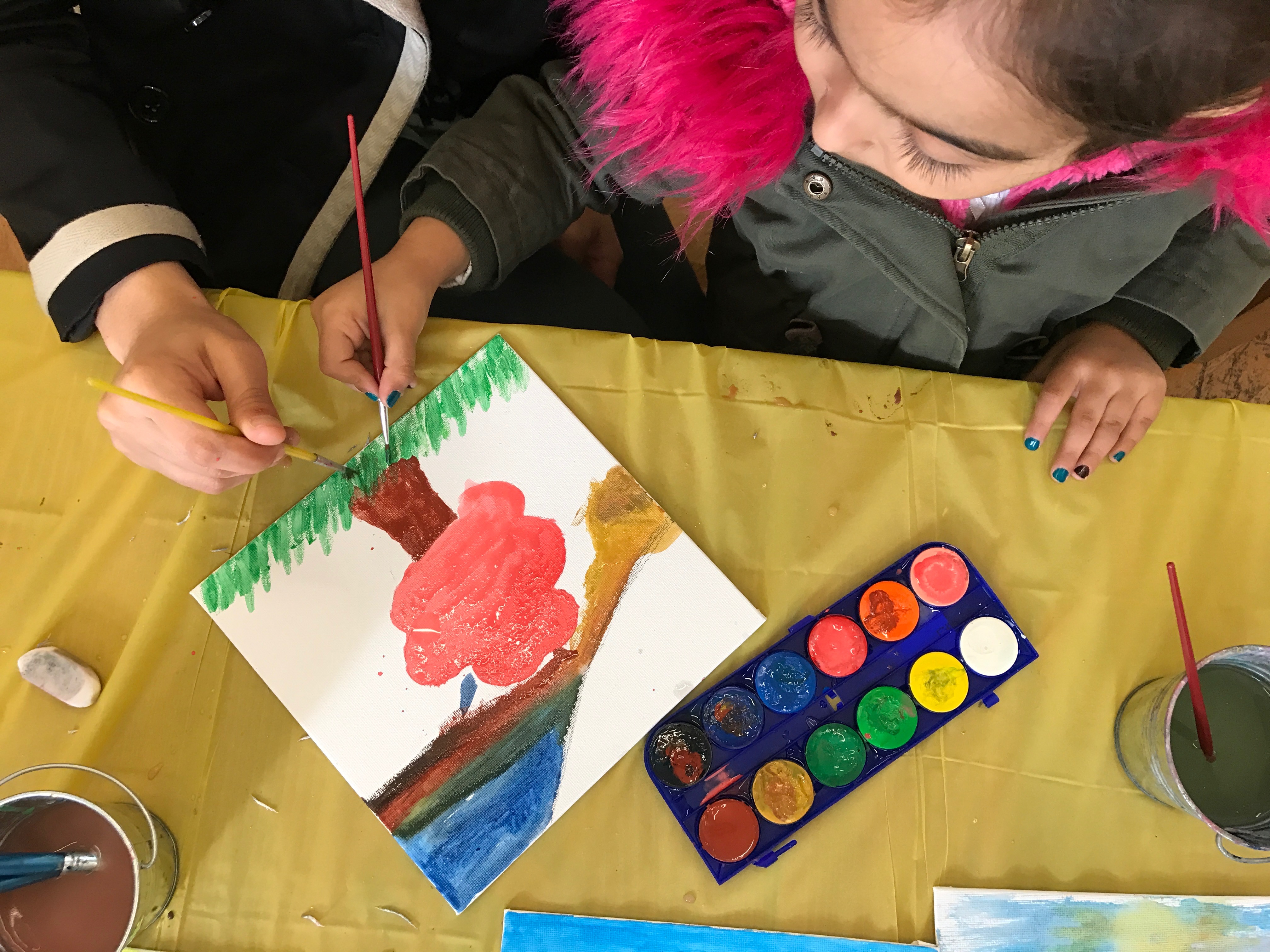
I purchase good quality paints, silver tins for water, colorful tablecloths, durable brushes, and encourage the refugees at my workshops to go in whatever direction they feel inspired. It’s very important for me to build a community when I facilitate these workshops, so they can rely on each other to ask for support when I’m not there. All of the materials are centered around sharing materials, sitting in connected circles – and if they prefer – displaying art on community walls.
On International Women’s Day, refugees approached my colorful table with hesitation examining the blank canvases, embellishments, and watercolors on the table. The project for the day was a Hand of Hamsa Community Mural project, to display the strength and courage they have in moving through spaces. We discussed what International Women’s Day means to them, as woman, daughters, and perhaps even as mothers. Once their piece was finished, we added the art to our completed mural composition. The sense of pride they had sharing their contribution and describing the techniques they used to create their own canvas was very humbling. Their level of confidence was different than what I had viewed before the workshop.
My workshops also include safe spaces for different members of the refugee crisis. The male voice has been muffled in the refugee crisis, seen as highly sexualized, aggressive, or criminal. I have led specialized workshops with 16-50 year old brothers, husbands, and fathers discussing themes such as fatherhood, safety, and redefining masculinity in a new journey. Using art, music, digital storytelling, meditation and dance to build safety and normalize feelings, refugees are able to express themselves in ways which one-on-one counseling limits.
Last week, at a refugee camp in Northern Greece, I led a similar workshop on what International Women’s Day means to the brothers and fathers in the camp. During my time there, I facilitated painting workshops throughout the week and they shared how much they needed this hour and how they had never painted like this before. Hearing this, I shifted the workshops into another creative direction, we discussed how male hands are seen as aggression and strength and if we were to use our hands to express ourselves, what would they say? They chose to paint the flags of their favorite football teams. They watch the game on their phones or play soccer with their friends when they are feel sadness showing up for them. The refugees painted their National flag with such pride and identity saying they would go back if it was safe. One brother painted the German flag hoping he can receive asylum one day to be reunited with his family and get a job to give back to the community.
Art can be scary and intimidating to those who have never explored it. We are told that an artist is one who creates a final end product that has financial value, yet the process often gets missed: when one of the refugees sits to work, they take part in a journey within themselves. They determine how elaborate and detailed they want to express themselves. They can assess what safety looks like to them among their fellow members in the circle. This sense of control contributes to a sense of dignity for those who have lost everything they had, to now barely be able to fill a grocery bag of possessions. Sitting in a small corner with a therapist describing their layers of trauma alone can feel very scary. It is a new world, a new language, with limited comprehension on how to describe their own conflicting feelings. Having a space to just let anything you feel out onto the paper and having the choice whether to describe it to others is the difference between the solitary therapy the UN provides and the freedom that healing arts provides.
One sister who was hesitant to take part in the art for twenty minutes, kept looking over and declined every offer saying she is not an artist. When she finally joined in, I was surprised at her ending thoughts: “I let it all go, everything in my body, I let it out. I don’t want to hold these dark feelings, so I picked up blue, black and purple and covered my entire art with it. I looked at it for a few moments to say goodbye to these fears. I then grabbed the yellow paint and glitter and created flowers all over. I want to grow. I want to be happy, from today on, I will no longer be scared. Allah is protecting me or I wouldn’t be here alive.”
I write this now, because I need your help to support more members of our Ummah like her. I have been here for almost four months now, and there is so much more healing arts work that need to be done. Please support me in donating to my Paypal account below. Help me provide crucial moments of healing for these resilient members of our Ummah.
Paypal: paypal.me/rabhibisla
Bio:
Rabhi Bisla, MFT MA is a PTSD Trauma Informed Care therapist, activist, storyteller, artist, ethnographic researcher, and daughter of resilient immigrants. With publications in three different outlets, she has specialized in grief and trauma with communities of color for 8 years now. As an ethnographic researcher at UCLA and Pepperdine, she led the way for research on the power of storytelling for Sept 11th Vicarious Trauma and PTSD Islamophobia survivors, further deconstructing the media’s War on Islam. Her research findings indicate the power of shared storytelling supports normalization and thus allows for a huge shift in compassion and healing of communities.
In December 2017, she loaded her suitcase with art materials and flew to Greece. Rabhi supports local organizations all over Greece with healing arts, digital storytelling, dance, yoga, & mindfulness to help refugees cope with the many different layers of trauma they are experiencing.
Comments.
No comments yet — be the first to comment!